Deprecated: Creation of dynamic property Yoast\WP\SEO\Presentations\Indexable_Term_Archive_Presentation::$robots is deprecated in /home/u821052763/domains/descubreparis.com/public_html/uat/wp-content/plugins/wordpress-seo/src/presentations/abstract-presentation.php on line 64
Deprecated: Creation of dynamic property Yoast\WP\SEO\Surfaces\Values\Meta::$canonical is deprecated in /home/u821052763/domains/descubreparis.com/public_html/uat/wp-content/plugins/wordpress-seo/src/surfaces/values/meta.php on line 202
Deprecated: Creation of dynamic property Yoast\WP\SEO\Surfaces\Values\Meta::$canonical is deprecated in /home/u821052763/domains/descubreparis.com/public_html/uat/wp-content/plugins/wordpress-seo/src/surfaces/values/meta.php on line 202
Deprecated: Creation of dynamic property WP_Term::$term_order is deprecated in /home/u821052763/domains/descubreparis.com/public_html/uat/wp-includes/class-wp-term.php on line 198
Deprecated: Creation of dynamic property WP_Term::$term_order is deprecated in /home/u821052763/domains/descubreparis.com/public_html/uat/wp-includes/class-wp-term.php on line 198
Deprecated: Creation of dynamic property WP_Term::$cat_ID is deprecated in /home/u821052763/domains/descubreparis.com/public_html/uat/wp-includes/category.php on line 378
Deprecated: Creation of dynamic property WP_Term::$category_count is deprecated in /home/u821052763/domains/descubreparis.com/public_html/uat/wp-includes/category.php on line 379
Deprecated: Creation of dynamic property WP_Term::$category_description is deprecated in /home/u821052763/domains/descubreparis.com/public_html/uat/wp-includes/category.php on line 380
Deprecated: Creation of dynamic property WP_Term::$cat_name is deprecated in /home/u821052763/domains/descubreparis.com/public_html/uat/wp-includes/category.php on line 381
Deprecated: Creation of dynamic property WP_Term::$category_nicename is deprecated in /home/u821052763/domains/descubreparis.com/public_html/uat/wp-includes/category.php on line 382
Deprecated: Creation of dynamic property WP_Term::$category_parent is deprecated in /home/u821052763/domains/descubreparis.com/public_html/uat/wp-includes/category.php on line 383
Deprecated: Creation of dynamic property WP_Term::$cat_ID is deprecated in /home/u821052763/domains/descubreparis.com/public_html/uat/wp-includes/category.php on line 378
Deprecated: Creation of dynamic property WP_Term::$category_count is deprecated in /home/u821052763/domains/descubreparis.com/public_html/uat/wp-includes/category.php on line 379
Deprecated: Creation of dynamic property WP_Term::$category_description is deprecated in /home/u821052763/domains/descubreparis.com/public_html/uat/wp-includes/category.php on line 380
Deprecated: Creation of dynamic property WP_Term::$cat_name is deprecated in /home/u821052763/domains/descubreparis.com/public_html/uat/wp-includes/category.php on line 381
Deprecated: Creation of dynamic property WP_Term::$category_nicename is deprecated in /home/u821052763/domains/descubreparis.com/public_html/uat/wp-includes/category.php on line 382
Deprecated: Creation of dynamic property WP_Term::$category_parent is deprecated in /home/u821052763/domains/descubreparis.com/public_html/uat/wp-includes/category.php on line 383
Deprecated: Creation of dynamic property WP_Term::$term_order is deprecated in /home/u821052763/domains/descubreparis.com/public_html/uat/wp-includes/class-wp-term.php on line 198
Deprecated: Creation of dynamic property WP_Term::$term_order is deprecated in /home/u821052763/domains/descubreparis.com/public_html/uat/wp-includes/class-wp-term.php on line 198
The post 5 Things You Need to Know About the Panthéon appeared first on UAT - DescubreParis.com.
]]>1 . Initially it was a Christian temple

In the year 508, on this hill, King Clovis built a basilica as tribute to the apostles, and it was meant to house his remains after his death, as well as his wife´s and those of Saint Genevieve. Later, when King Louis XV was gravely ill he sent for the construction, in 1744, of a prestigious monument dedicated to the patron saint of Paris, Saint Genevieve, since he believed the saint had cured him. It was also done as a way of earning goodwill among the citizens and have a monument that would symbolize his time as King. This is why it was first known as a Christian church.
2 . It turned into a civilian monument after the Revolution

After all the changes that took place in France after the French Revolution, this building also changed into a place of civilian use. Victor Hugo was the first literary figure to be buried there in 1885. It must be said that this building, as well as all transformations it went through, had strong political motivations that remain even today. Its main purpose now is to house the remains of people who made important contributions to the French ideals, from the sciences (with Pierre and Marie Curie) to literature (with Victor Hugo, Emile Zola, among others), and philosophy and politics (with Voltaire and Rousseau) just to mention a few. There are even some modern political figures such as Simone Véil, a defender of women’s rights and the European Project. The President of the Republic is the one who decides who gets to rest for eternity in the Panthéon.
3 . It was a technical achievement of its time

The giant, 15,000 ton dome is made up of three different stone domes on top of each other, one inside the other; they all rest on four pillars and it is a technical and mathematical achievement for its time. It mixes Greek temples, Christian sanctuaries, and humanism. It was a creation of architect Jacques-Germain Sufflot, who was a leading edge figure during the Age of Enlightenment. Sufflot was one of the first people to study the Greek temples remaining in the south of Italy and breaking with the ornamental traditions of his time.
4 . The Foucault Pendulum is found inside

Léon Foucault is a French physicist who was authorized in 1851 to set up a pendulum that hangs from the dome and demonstrates that Earth rotates on its own axis. This instrument is located in the center of the building and allows us to witness how the pendulum isn’t really turning but is the earth the one that rotates. To see this there are markings around a circle that signal how the position of the pendulum changes a certain number of degrees every hour, according to a quadrant. Fans of math and physics will enjoy this.
5 . You can go all the way to the top
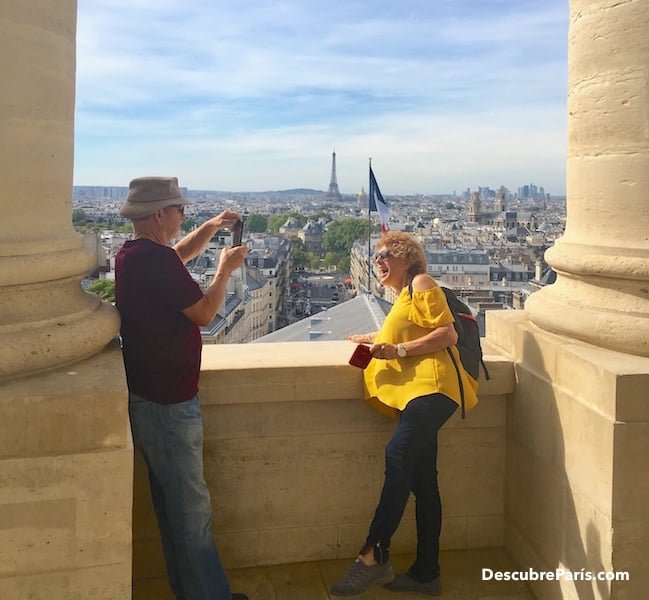
Between April and October, and paying an extra fee of 3€, you can access the outside columns of the Panthéon in Paris. There are 206 steps and it is done in three separate flights of stairs, same thing for going down.
After the first flight you can see the inside from above, the insides of the Panthéon and its amazing proportions. Then you can access a mezzanine that will give you interesting views of the Rue Soufflot, the rooftops of Paris, and the Eiffel Tower. Lastly, if you go through a pair of slightly hidden doors (you can see them from the ground floor) you get to the outside columns where you get a 360° view of Paris. We highly recommend it.
Important fact: Who was Saint Genevieve?

Saint Genevieve is the patron saint of Paris, she was an impassioned Christian, often described as a peasant who became part of history towards the end of the Roman domination. In the year 451 Genevieve urged the people to pray and resist the Huns that were circling Lutetia. Thanks to her, Attila is defeated. When she died, in 502, she was buried close by, on top of that famous hill which was considered a sacred place and the center of the city.
Above her grave there was erected a small oratory that became a place of pilgrimage. In the year 508, King Clovis has a basilica built, as a tribute to the apostles, in the same place as the oratory and asks that he be buried next to the Saint who inspired his decision to change the capital of the Kingdom to Lutetia.
She is closely tied to the history of France and precedes Joan of Arc. Just like her, Genevieve represents the ideals of freedom and resistance that the Third Republic advocated for at the end of the Siege of Paris, this is why she is such an important figure within the Panthéon, in the main fresco inside the dome she is immortalized next to kings and emperors.
A suggestion by Descubre Paris:

Whether or not you have time to go inside the Panthéon in Paris, we suggest you find the benches that the City Hall has placed around the building. Some are giant slabs of stone and others are wooden benches carved with the names of 200 women who have made important contributions to different areas of knowledge but erased by history. You can take a little break by the Sorbonne, the city hall for arrondissement 5 and, of course, the beautiful architecture of the Panthéon.
Practical information for visiting the Panthéon in Paris:
This is some good information to have, remember that it may change due to events being held at the Panthéon. For more information go to the official website.
Location: Place du Panthéon, arrondissement 5, at one end of the Luxembourg Gardens.
Schedule: open every day from 10:00 a.m.- 6:00 p.m., except on January 1st, May 1st, and December 25th. Between April and October it remains open until 6:30 p.m.
Price: Adult access costs 11.50€. It is free of charge for people under 18 year of age, and for people between the ages of 18 -25 who are residents of the European Union and people with disabilities with one attendant.
Access to the top part of the Panthéon will be 3€ extra and the audio guide is also 3€.
Access: You can get there by metro, Line 10, the RER B, or by bus with routes 21, 27, 38, 82, 84, 85, and 89. Get our ready-to-download Detailed Guides, available in our online shop, so you can enjoy your Paris visit without wasting any time.
Paris is waiting for you.
A bientôt
The post 5 Things You Need to Know About the Panthéon appeared first on UAT - DescubreParis.com.
]]>Deprecated: Creation of dynamic property WP_Term::$term_order is deprecated in /home/u821052763/domains/descubreparis.com/public_html/uat/wp-includes/class-wp-term.php on line 198
Deprecated: Creation of dynamic property WP_Term::$term_order is deprecated in /home/u821052763/domains/descubreparis.com/public_html/uat/wp-includes/class-wp-term.php on line 198
Deprecated: Creation of dynamic property WP_Term::$cat_ID is deprecated in /home/u821052763/domains/descubreparis.com/public_html/uat/wp-includes/category.php on line 378
Deprecated: Creation of dynamic property WP_Term::$category_count is deprecated in /home/u821052763/domains/descubreparis.com/public_html/uat/wp-includes/category.php on line 379
Deprecated: Creation of dynamic property WP_Term::$category_description is deprecated in /home/u821052763/domains/descubreparis.com/public_html/uat/wp-includes/category.php on line 380
Deprecated: Creation of dynamic property WP_Term::$cat_name is deprecated in /home/u821052763/domains/descubreparis.com/public_html/uat/wp-includes/category.php on line 381
Deprecated: Creation of dynamic property WP_Term::$category_nicename is deprecated in /home/u821052763/domains/descubreparis.com/public_html/uat/wp-includes/category.php on line 382
Deprecated: Creation of dynamic property WP_Term::$category_parent is deprecated in /home/u821052763/domains/descubreparis.com/public_html/uat/wp-includes/category.php on line 383
Deprecated: Creation of dynamic property WP_Term::$cat_ID is deprecated in /home/u821052763/domains/descubreparis.com/public_html/uat/wp-includes/category.php on line 378
Deprecated: Creation of dynamic property WP_Term::$category_count is deprecated in /home/u821052763/domains/descubreparis.com/public_html/uat/wp-includes/category.php on line 379
Deprecated: Creation of dynamic property WP_Term::$category_description is deprecated in /home/u821052763/domains/descubreparis.com/public_html/uat/wp-includes/category.php on line 380
Deprecated: Creation of dynamic property WP_Term::$cat_name is deprecated in /home/u821052763/domains/descubreparis.com/public_html/uat/wp-includes/category.php on line 381
Deprecated: Creation of dynamic property WP_Term::$category_nicename is deprecated in /home/u821052763/domains/descubreparis.com/public_html/uat/wp-includes/category.php on line 382
Deprecated: Creation of dynamic property WP_Term::$category_parent is deprecated in /home/u821052763/domains/descubreparis.com/public_html/uat/wp-includes/category.php on line 383
Deprecated: Creation of dynamic property WP_Term::$term_order is deprecated in /home/u821052763/domains/descubreparis.com/public_html/uat/wp-includes/class-wp-term.php on line 198
Deprecated: Creation of dynamic property WP_Term::$term_order is deprecated in /home/u821052763/domains/descubreparis.com/public_html/uat/wp-includes/class-wp-term.php on line 198
Deprecated: Creation of dynamic property WP_Term::$term_order is deprecated in /home/u821052763/domains/descubreparis.com/public_html/uat/wp-includes/class-wp-term.php on line 198
The post 5 Things You Should Know About the Sainte Chapelle appeared first on UAT - DescubreParis.com.
]]>1. It was built to house the Crown of Thorns of Christ (and 22 other relics):
To gain its name of Sainte, this chapel had to be built to house relics. This is the case of this surprising chapel, commissioned by King Louis IX of France to keep Christ’s Crown of Thorns and also his collection of 21 other relics he had collected. The political reasoning of Saint Louis, who was a very pious king, was to make France the new Christian capital, competing with cities like Rome.
Check this out: Today no relics remain in the place. The Crown of Thorns (or what remains of it) and the Shirt of Saint Louis are now part of the Treasure of Our Lady of Paris (Notre-Dame de Paris). After the fire at Notre-Dame, the relics were moved to the Saint-Germain-l’Auxerrois church, behind the Louvre Museum. They can be visited only the first Fridays of each month and every Friday during Lent at 3:00 p.m.
2. It has two chapels, upper and lower:
The lower chapel is the one that welcomes in visitors (along with the boutiques and gift shops) and seems to be almost like a vault at 23 ft (7 meters) high, held by multiple columns. To the left of the entrance you can find the stairs that will lead you to the upper chapel, where you can witness the play of light, colors, and architecture of this beautiful building.
Check this out: The columns in the upper chapel represent the twelve apostles, pillars of the church of Christ.
3. It counts with 1,113 stained glass windows that narrate episodes of the Bible:
Starting with Genesis to the Apocalypse. Even King Louis IX is represented in one of them. Suggestion: when you arrive, look for the informational cards that are available in several languages for visitors. This will help you better understand the stories behind the stained glass windows. Try to look at them from a distance to better appreciate them.
Check this out: the rosette in the back represents the Apocalypse and was renovated in 1490. During that time renovation meant “keeping up with trends”, therefore certain parts of the building weren’t actually being restored. They were updated to resemble the architectural trend of that time, which was Gothic Flamboyant (this meant flame shapes or fire), and not the original Gothic Rayonnant (referring to strong lines coming out of the center, creating rays of light) which you will likely see at Notre-Dame.

4. The best time to visit is the morning:
Try to get there early since this building, due to its diminutive size, fills up very quickly. Hopefully you get to see the sunlight through the stained glass windows brightening up the space. Imagine it is 1248 and the floor is white, which further reflected the colors of the windows creating an even more…heavenly atmosphere. The visit will take you 45 minutes to an hour. Because the monument is inside the Palace of Justice you will have to go through the corresponding security checks. A lot of people don´t get to see this monument because they get discouraged by the queues outside, remember that it is a small place, but if you get there early you will have no trouble, and it is very much worth the effort.
5. You can buy a bundled ticket to visit the Conciergerie as well:
A few feet away from the entrance to the Sainte Chapelle you will find the Conciergerie which preserves some of the ancient vestiges of the Palace de la Cité and medieval housing for the kings of France. During the French Revolution it served as prison (that is where Marie Antoinnete was held before being sent to the guillotine). Today it also functions as the Palace of Justice and has a building for the Correctional Police. Some wonder why they should pay to visit a church, but this is really a museum with the name of a church, since there is no religous worship inside.
Suggestion: when purchasing your ticket, think about if you’d like to also visit the Conciergerie. The regular ticket to visit the Sainte Chapelle costs 10€ and the Conciergerie costs 9€. If you buy the bundle you will pay 15€ for both (saving 4€).

This building, inspired by the vision of New Jerusalem, is part of our detailed guide Discover Paris in 4 Days which you can get here.
BONUS: You will likely leave through the Palace of Justice, through a big portal of black and golden gates. If that is the case, turn immediately to your left and walk to the corner so you can see the clock tower and in it in the first public clock in Paris. A jewel from 1370.
You can also read our article about the Top 5 churches in Paris.
Address:
Sainte-Chapelle
8, boulevard du Palais
75001 Paris
Metro Cité, Line 4
The schedule for the Sainte Chapelle are:
⦁ From January 2nd to March 31st: Open every day from 9:00 a.m. to 17:00 p.m.
⦁ From April 1st to September 30th: Open every day from 9:00 a.m. to 19:00 p.m.
⦁ From October 1st to December 31st: Open every day from 9:00 a.m. to 17:00 p.m
⦁ Last entrance: half an hour before closing time.
Paris awaits!
A bientôt.
The post 5 Things You Should Know About the Sainte Chapelle appeared first on UAT - DescubreParis.com.
]]>Deprecated: Creation of dynamic property WP_Term::$term_order is deprecated in /home/u821052763/domains/descubreparis.com/public_html/uat/wp-includes/class-wp-term.php on line 198
Deprecated: Creation of dynamic property WP_Term::$cat_ID is deprecated in /home/u821052763/domains/descubreparis.com/public_html/uat/wp-includes/category.php on line 378
Deprecated: Creation of dynamic property WP_Term::$category_count is deprecated in /home/u821052763/domains/descubreparis.com/public_html/uat/wp-includes/category.php on line 379
Deprecated: Creation of dynamic property WP_Term::$category_description is deprecated in /home/u821052763/domains/descubreparis.com/public_html/uat/wp-includes/category.php on line 380
Deprecated: Creation of dynamic property WP_Term::$cat_name is deprecated in /home/u821052763/domains/descubreparis.com/public_html/uat/wp-includes/category.php on line 381
Deprecated: Creation of dynamic property WP_Term::$category_nicename is deprecated in /home/u821052763/domains/descubreparis.com/public_html/uat/wp-includes/category.php on line 382
Deprecated: Creation of dynamic property WP_Term::$category_parent is deprecated in /home/u821052763/domains/descubreparis.com/public_html/uat/wp-includes/category.php on line 383
Deprecated: Creation of dynamic property WP_Term::$term_order is deprecated in /home/u821052763/domains/descubreparis.com/public_html/uat/wp-includes/class-wp-term.php on line 198
Deprecated: Creation of dynamic property WP_Term::$term_order is deprecated in /home/u821052763/domains/descubreparis.com/public_html/uat/wp-includes/class-wp-term.php on line 198
Deprecated: Creation of dynamic property WP_Term::$term_order is deprecated in /home/u821052763/domains/descubreparis.com/public_html/uat/wp-includes/class-wp-term.php on line 198
The post Visiting Guide for the Musée d’Orsay in Paris appeared first on UAT - DescubreParis.com.
]]>This is one of the most beautiful places in the City of Light. The Musée d’Orsay used to be an antique train station built by the Paris-Orléans railway company, it was finished just in time for the 1900 Exposition Universelle. Due to its location and the work it would require to update the railways it became “obsolete”, it was left abandoned for some years until it was declared a national monument in 1973 and, thanks to an initiative of President Georges Pompidou, it became the home of stunning artwork by impressionist artists such as: Monet, Manet, Renoir, Cézane, and even Van Gogh. Orsay is much smaller and easier to visit than the Louvre, but the beauty of its paintings has nothing to envy it. Don´t forget to admire the beautiful clocks found in the main lobby and on the east and west ends. As we like to do here in Descubre París, we have created a small guide to help you explore this museum. Of course, it all depends on how curious or passionate you are about art, but we believe this is a place worth visiting, which is why we give you the basic information and some step-by-step tricks to make the most of your visit.
Practical Information

Schedule:
Tuesdays, Wednesdays, Fridays, Saturdays and Sundays from 9:30 a.m. to 18:00 (6 p.m.) and Thursdays from 9:30 a.m. to 21:45 (9:45 p.m.). It is closed every Monday, on May 1st, and on December 25th.
Best days to visit:
- Thursdays during the night shift: 18:00 (6 p.m.) to 21:45 (9:45 p.m.)
- Wednesdays and Fridays
Prices:
The full ticket costs 14€. Entry is free: the first Sunday of the month, for people under 18 years of age, for EU residents between 18 and 25 years of age.
Buying tickets beforehand will raise the ticket price, approximately, to 15,40€.
Making every cent count:
If you will be spending more than one day in Paris and are very interested in seeing other museums we recommend buying tickets in packages:
- You can buy ticket bundles (jumelé) with the l’Orangerie Museum, for 18€ (unbundled: 23€).
- You can buy ticket bundles (jumelé) with the Rodin Museum, for 21€ (unbundled: 26€).
- If you save your ticket you can use it during the following 8 days from day-of-purchase to visit, at a reduced rate, the Garnier Opera, the Gustave Moreau National Museum and the Jean-Jaques Henner National Museum.
To Eat:

The museum has several dining options and although in our Detailed Travel Guides we recommend another restaurant outside the museum, we also consider it important that you know of the available options.
- Café de l’Ourse (The Bear Café): gets its name from the sculpture of a polar bear right next to it. It is a small cafeteria with small plates like chips, salads, and ready to eat sandwiches. Prices start at 5,9€ for a sandwich. There are also breads, pastries, and drinks.
- The Bell Café: a restaurant located behind the impressionists gallery, on the fifth floor. Dishes here are a little more elaborate, and the prices a little higher; it’s more like a casual restaurant. Appetizers start at 9€, entrées between 14€ and 16€, and desserts between 6€ and 16€.
- Le Restaurant: located on the French First Floor (that is a second floor to everybody else) and it’s from the year 1900. It has fixed “Appetizer and Entrée” or “Appetizer and Dessert” menus for 24,5€ and a “Appetizer, Entrée, and Dessert” menu for 31€. If that is not what you want, appetizers go from 12€ to 20€, main dishes from 17€ and 28€, and desserts from 8€ to 15€. Prices are pretty good for the type of restaurant. If you have the time and possibility there is a package that includes museum entry tickets and dinner at the restaurant for 63€ (reservation only).
How to visit the d’Orsay Museum
This is our suggested step-by-step guide:
- Once you get to the museum, if you already have your ticket, you should go to door C. If not, you should go to the ticket booth and buy your tickets. Remember that you can also purchase audio guides.
- Once you pass the security checkpoint you will have to validate your ticket (or buy it and then validate it) with the people at the access point.
- If you would like to put a back-pack or any bags in storage you can do it for free, turn immediately to your right after the ticket checkpoints. We suggest you go into to the museum with as little extra weight as possible so you avoid exhaustion.
- After that, go to the main lobby. You will find maps in Spanish or English to your right. If you need it, we suggest you take one to find your way more easily. If you bought the audio guide you should turn to your left.
- Return to the main lobby and you will be standing under one of the famous clocks inside this wonderful museum.

Orsay Museum, Paris. Photos © Descubre París - We suggest you cross the Central Hall with the sculptures, taking them in, off course, but go straight to the end and look for the escalators. Go all the way to the fifth floor and begin your visit top to bottom.
- Before you reach the escalators you will pass a space dedicated to the Garnier Opera where there is a scaled model of the neighborhood this amazing building is located in. Take your time looking through it.
On the fifth floor:
- When you get to the 5th floor you will find another one of the famous clocks within the building. It is a well known spot in the museum, you can see the Louvre across the Seine and Montmartre in the back. Once you´ve enjoyed the view (and taken a picture), you can start your stroll on this floor.

Orsay Museum, Paris. Photos © Descubre París - This floor has the Impressionism and Neo-Impressionism gallery: Cézanne, Degas, Manet, Monet, Pissarro, Renoir, Sisley, Seurat and many more.

Orsay Museum, Paris. Photos © Descubre París - You can see each room in a circle and then move on to the next one.
- Right now there are some rooms recently renovated. Right now there are some rooms recently renovated. These are the rooms that housed the pieces by Van Gogh and Gauguin.
- At the end you can find the Bell Café, and the second clock.
On the 4th and 3d Floor:
- The fourth floor has a gallery of decorative arts of Great Britain and Austria, (right on the side where you arrive on the floor).
- The third floor is for Scandinavia and Germany.
- We recommend focusing on the 5th, 2nd, and 0 floors.
Keep Going Down to the 2nd Floor:
- On the second floor you will find a long hallway and, between the rooms, sculptures (from 1880 to 1900) by artists such as Rodin and Claudel, among others.

Orsay Museum, Paris. Photos © Descubre París - There is a whole exhibition of Art Nouveau (from Belgium, Spain, France, and Italy).
- There is a hall for Post-Impressionism, Symbolism, and the different currents of Post-Impressionism.
- You can go turn around to see the other side and visit the gallery in front.
Now Keep Going Down to Floor 0:
- It is likely that after going to the Floor 0 or RDC in French (Rez-de-chaussée) you will find yourself once again under the clock. If that is the case, with the clock behind you, start in your right, following the map and starting in the room for Academic Art. If not, you can start with rooms 24 and 23 and keep going down according to the order shown in the map; there is an order to everything according to art history and/or styles. It is likely that you will be doing some back and forth. Let yourself be guided by the order of the rooms, that way you can rest a little between galleries.

Orsay Museum, Paris. Photos © Descubre París - On this floor you will find decorative art from the Second Empire: Cézanne, Manet, Courbert among others.
- On this floor you will also find temporary exhibitions, you will have to pay a separate ticket to access them.
Finally:
- You exit through the gift shop and get a little souvenir if you wish to.
- Don´t forget to pass by the lockers (vestiaire) to retrieve your coats and belongings, if you left anything on your way in.
- On your way out, don’t forget to appreciate the animal sculptures found on the entrance plaza of the museum. They are very beautiful.
Whether you have one of our Detailed Travel Guides or not, we suggest taking a break (weather permitting), on the stairs in front of the museum which have a view to the Seine.
If you have one of our Detailed Travel Guides you can take some time to see what is next in your itinerary (probably where to eat if your museum visit was in the morning).
We hope this mini guide was useful and that you can make the most out of your visit to one of the most beautiful museums in the city.
Paris is waiting for you.
À bientôt!
The post Visiting Guide for the Musée d’Orsay in Paris appeared first on UAT - DescubreParis.com.
]]>Deprecated: Creation of dynamic property WP_Term::$term_order is deprecated in /home/u821052763/domains/descubreparis.com/public_html/uat/wp-includes/class-wp-term.php on line 198
Deprecated: Creation of dynamic property WP_Term::$cat_ID is deprecated in /home/u821052763/domains/descubreparis.com/public_html/uat/wp-includes/category.php on line 378
Deprecated: Creation of dynamic property WP_Term::$category_count is deprecated in /home/u821052763/domains/descubreparis.com/public_html/uat/wp-includes/category.php on line 379
Deprecated: Creation of dynamic property WP_Term::$category_description is deprecated in /home/u821052763/domains/descubreparis.com/public_html/uat/wp-includes/category.php on line 380
Deprecated: Creation of dynamic property WP_Term::$cat_name is deprecated in /home/u821052763/domains/descubreparis.com/public_html/uat/wp-includes/category.php on line 381
Deprecated: Creation of dynamic property WP_Term::$category_nicename is deprecated in /home/u821052763/domains/descubreparis.com/public_html/uat/wp-includes/category.php on line 382
Deprecated: Creation of dynamic property WP_Term::$category_parent is deprecated in /home/u821052763/domains/descubreparis.com/public_html/uat/wp-includes/category.php on line 383
Deprecated: Creation of dynamic property WP_Term::$term_order is deprecated in /home/u821052763/domains/descubreparis.com/public_html/uat/wp-includes/class-wp-term.php on line 198
The post Five Things to Discover About the Ópera Garnier appeared first on UAT - DescubreParis.com.
]]>The Ópera Garnier is part of the Paris Opera, which has two buildings. One of them is the Opéra Bastille, completely modern but equally important, and the other one is the Palais Garnier also known as the Ópera Garnier. In addition to the five fun facts we will share about this wonderful and surprising building, you can also find more information in our Detailed Travel Guides of three, four, and five days.
1 . The Opéra Garnier was built after an assassination attempt
En 1858, Emperor Napoleon III and his wife, Eugenia, were subject of an assassination attempt on their way to the Opéra Le Peletier. The Emperors suffered no harm, but there were many injured and dead. Napoleon III noticed that it was hard to guarantee safety measures on the narrow streets of old Paris. This is why he decided to add to the modernization project by Baron Haussmann the construction of a new opera in the newer neighborhoods in Paris. A contest was held in place to select the architect and it was won by the young Charles Garnier, who was only 35 at the time. Construction lasted 15 years and the opera was inaugurated on January 5th of 1875.
Fun Fact: Charles Garnier was practically unknown before he participated in the contest to build the Opera of Paris. He went on to win the Prix de Rome in Architecture, and was chosen in the Institut de France, in the Fine Arts Academy
2 . The Opéra Garnier has a style of its own, inspired by the past

Garnier wanted to create a style of his own. He searched for inspiration in the great works of the past, and reworked them adding color, and visual and decorative richness. The grand staircase is of classic inspiration and the abundant decoration is baroque, but Garnier added color by using marble of different shades and origins. You can also see the influence of the Sistine Chapel and the Hall of Mirrors in Versailles. Garnier merged the two architectural influences in one place by creating the impressive Grand Foyer. The ceiling was painted by Paul Baundry and it depicts themes such as the history of music.
Fun Fact: the lyre is one of the main objects present in the decoration of the room. The same lyre is held by Apollo in the high point of the theatre. Apollo is the Greek God of the arts, and in this case he is accompanied by Music and Poetry, represented by the two women on his sides.
3 . Garnier wanted to create a “theatre within the theatre”

Garnier was very aware of the kind of people that assisted to the opera. It was the rich and powerful personalities who went often. The architect took into account all details and every space was thought so that it showcased the assistants. For example, through the Pavillon des Abonnés, a circular room, he wanted the “subscribers” to feel as though they were entering a place filled with mystery and surprises. The Grand Staircase, of huge proportions and surrounded by balconies, had the purpose of allowing attendees to see and being seen. For women to parade in their dresses and feel like stars. The color of the room, for example, red and gold was selected by Garnier because he felt the reflection of the color would make the women look more beautiful.
Fun Fact: all throughout 2019 the piece Les Saturnales was on display, they were neon light circles distributed along the lower floors and giant golden wheels placed in the center of the Grand Staircase. The installation is a work by Claude Lévêque, a visual artist invited by the National Opera to celebrate its 350 years and the 30 years of the Opéra Bastille. Another thing to know about the National Opera is that its building is older than the construction of Opéra Garnier. It was Louis XIV who established the Royal Academy of Music, which preceded the National Opera and the Opéra Garnier. This is why above the curtain you can see a symbol of the Sun King.
4 .

Something that may cause a lot of surprise is that people used to go to the opera a lot more often. It was like hanging out in your house, talking and doing other things with the show as a background. Additionally, it was normal to arrive late, because the important people (supposedly) were very busy. This is why the main act (the ballet) was in the third place, to give people time to arrive. It was thanks to the influence of important characters, such as Wagner, that going to the opera took an almost religious importance, where silence was golden and punctuality expected.
Fun Fact: an opera can last between two and three hours (with two breaks), they are generally performed in Italian, French or German (with subtitles in English), and the music is played by the orquestra. In the Opéra Garnier, you can not only see operas but also ballet, concerts and recitals. Prices vary from 12€ to 160€ depending on location and type of show.
5 . The auditorium was designed for people watching

The auditorium has capacity for 2.081 people. It is shaped like a horseshoe, following Italian tradition, but it is French in its organization by category. As we mentioned before, Garnier wanted the assistants to also be part of the show which is the reason for the shape and color of the auditorium, and the placement of the chairs and boxes; of course without taking attention away from the stage.
Fun fact: the ceiling you can see today is not the original, which was damaged by the gas exuded from the gas lights. In 1960 it was replaced with artwork by Chagall, taking advantage of the low assistance to the opera during the post-war times. The inauguration of the controversial ceiling tripled assistance. The artwork recalls important artists in a symphony of colors that meant to usher in the new turn of the century.
We had to add an extra thing to our list…
6 . The Phantom of the Opera existed

At least that is what Gaston Leroux says in his fascinating book The Phantom of the Opera. This ghost is so famous that he has his own box, box number five. Leroux narrates with passion and conviction a tale of sadness and mystery that surrounds the phantom of the opera. In reality Leroux was inspired by the story of a pianist who survived the fire of the Opéra Lepeletier where his girlfriend died. It is said that the pianist took refuge in the underground lake of the Opéra Garnier until he died. All of this was used as material for Leroux´s creation, who intertwined several tragic events that actually happened in the opera (like the fall of a counterweight on top of a spectator) with an imagined character that came to life thanks to this book.
All you need to know to visit it
These are just some interesting facts about the Opéra Garnier, but the truth of the matter is that you should see this place with your own eyes. It is surprising and awe-inspiring. Do not hesitate to walk all of its corners, discover the Salón Du Glacier, the Avant-Foyer, the Foyer, Grand Foyer, and the Loggia, which is a large balcony from where you can see the Avenue de l’Opéra.
Don´t miss the Sun and Moon Auditoriums, two opposing rooms, between the Grand Staircase and the Grand Foyer. They are small, but we love their ceilings and infinity mirror.
Practical Information*:
To visit de Opéra Garnier you have to take into account if there are performances being held, if there is it is closed to the public. To know which days are open to the public you should visit the official website to choose your visiting day.
Going to a show is another way to visit the Paris Opera. On many occasions you can get tickets at a very low price (if there are seats available). Keep in mind that opera pieces can be very long.
We also suggest getting the audio-guide. It costs 5€ but it’s very worthwhile, they explain in depth all the details of the building and guide you every step of the way.
Prices:
Between 12€ and 14€ depending on if there is a performance at the time.
Audioguide: 5€
Visiting hours: between 10:00 a.m. and 4:30 p.m., except in cases of unexpected closure due to events.
Access:
Opera Stop, Lines 3, 7 and 8
Chaussée d’Antin Stop, Lines 7 and 9
Auber Stop, Line RER A
Visitor access is through one of the back corners.. First you go through a security check and then you access the ticket booth to acquire your tickets.
*All of this is just informative. Remember to always look for up-to-date information on the official Paris Opera website.
If you are coming to Paris and don’t know where to start, we can help you!
Paris is waiting for you. À bientôt.
À bientôt.
The post Five Things to Discover About the Ópera Garnier appeared first on UAT - DescubreParis.com.
]]>Deprecated: Creation of dynamic property WP_Term::$term_order is deprecated in /home/u821052763/domains/descubreparis.com/public_html/uat/wp-includes/class-wp-term.php on line 198
Deprecated: Creation of dynamic property WP_Term::$term_order is deprecated in /home/u821052763/domains/descubreparis.com/public_html/uat/wp-includes/class-wp-term.php on line 198
Deprecated: Creation of dynamic property WP_Term::$term_order is deprecated in /home/u821052763/domains/descubreparis.com/public_html/uat/wp-includes/class-wp-term.php on line 198
Deprecated: Creation of dynamic property WP_Term::$cat_ID is deprecated in /home/u821052763/domains/descubreparis.com/public_html/uat/wp-includes/category.php on line 378
Deprecated: Creation of dynamic property WP_Term::$category_count is deprecated in /home/u821052763/domains/descubreparis.com/public_html/uat/wp-includes/category.php on line 379
Deprecated: Creation of dynamic property WP_Term::$category_description is deprecated in /home/u821052763/domains/descubreparis.com/public_html/uat/wp-includes/category.php on line 380
Deprecated: Creation of dynamic property WP_Term::$cat_name is deprecated in /home/u821052763/domains/descubreparis.com/public_html/uat/wp-includes/category.php on line 381
Deprecated: Creation of dynamic property WP_Term::$category_nicename is deprecated in /home/u821052763/domains/descubreparis.com/public_html/uat/wp-includes/category.php on line 382
Deprecated: Creation of dynamic property WP_Term::$category_parent is deprecated in /home/u821052763/domains/descubreparis.com/public_html/uat/wp-includes/category.php on line 383
Deprecated: Creation of dynamic property WP_Term::$cat_ID is deprecated in /home/u821052763/domains/descubreparis.com/public_html/uat/wp-includes/category.php on line 378
Deprecated: Creation of dynamic property WP_Term::$category_count is deprecated in /home/u821052763/domains/descubreparis.com/public_html/uat/wp-includes/category.php on line 379
Deprecated: Creation of dynamic property WP_Term::$category_description is deprecated in /home/u821052763/domains/descubreparis.com/public_html/uat/wp-includes/category.php on line 380
Deprecated: Creation of dynamic property WP_Term::$cat_name is deprecated in /home/u821052763/domains/descubreparis.com/public_html/uat/wp-includes/category.php on line 381
Deprecated: Creation of dynamic property WP_Term::$category_nicename is deprecated in /home/u821052763/domains/descubreparis.com/public_html/uat/wp-includes/category.php on line 382
Deprecated: Creation of dynamic property WP_Term::$category_parent is deprecated in /home/u821052763/domains/descubreparis.com/public_html/uat/wp-includes/category.php on line 383
Deprecated: Creation of dynamic property WP_Term::$cat_ID is deprecated in /home/u821052763/domains/descubreparis.com/public_html/uat/wp-includes/category.php on line 378
Deprecated: Creation of dynamic property WP_Term::$category_count is deprecated in /home/u821052763/domains/descubreparis.com/public_html/uat/wp-includes/category.php on line 379
Deprecated: Creation of dynamic property WP_Term::$category_description is deprecated in /home/u821052763/domains/descubreparis.com/public_html/uat/wp-includes/category.php on line 380
Deprecated: Creation of dynamic property WP_Term::$cat_name is deprecated in /home/u821052763/domains/descubreparis.com/public_html/uat/wp-includes/category.php on line 381
Deprecated: Creation of dynamic property WP_Term::$category_nicename is deprecated in /home/u821052763/domains/descubreparis.com/public_html/uat/wp-includes/category.php on line 382
Deprecated: Creation of dynamic property WP_Term::$category_parent is deprecated in /home/u821052763/domains/descubreparis.com/public_html/uat/wp-includes/category.php on line 383
Deprecated: Creation of dynamic property WP_Term::$term_order is deprecated in /home/u821052763/domains/descubreparis.com/public_html/uat/wp-includes/class-wp-term.php on line 198
Deprecated: Creation of dynamic property WP_Term::$term_order is deprecated in /home/u821052763/domains/descubreparis.com/public_html/uat/wp-includes/class-wp-term.php on line 198
Deprecated: Creation of dynamic property WP_Term::$term_order is deprecated in /home/u821052763/domains/descubreparis.com/public_html/uat/wp-includes/class-wp-term.php on line 198
The post Everything You Need to Know to Visit the Eiffel Tower appeared first on UAT - DescubreParis.com.
]]>We want to dedicate a blog post to this wonderful building, just as we love to do in DescubreParis.com, with practical and useful information for visiting the most photographed monument in the world.
First, a Little Bit of History
The Eiffel Tower was built by engineer and builder Gustave Eiffel, a specialist on metallic structures, with the help of 300 workers for the Exposition Universelle of 1889. Its construction took two years. At the time it was the tallest building in the world at 276 meters high (301 yards).
Nowadays, the tower welcomes around 7 million visitors per year and is worth an estimated 434 billion Euros, that is a fifth part of the French GDP.
How is the Eiffel Tower Set Up?

Today, the Iron Lady is framed by a security glass installation at its lower level, the ground level is a patio (parvis), there are three floors (accessible by different ways), and each has different things to observe, besides enjoying the amazing view. It is important to remember this since at the moment of buying your ticket you should know how far up the tower you want, or can, go.
The Patio orParvis
Once you´ve gone through the first access checkpoints you arrive to the patio where you can find:
- Access to the elevators
- Access to the stairs to the first floor
- Restaurant, more like a concession stand
- An incredible view of the internal structure of the tower
- Exits
The First Floor (Premier étage)
- 57 meters above ground (187 Feet)
- Only accessible by elevator (or when coming down from the above floors, or if you have a reservation at the restaurant Le 58 Tour Eiffel)
- It has a 57-meters-long (187 feet) glass floor, to experience a floating view; don´t worry, not the whole floor is like this.
- Viewpoints and rest areas for enjoying the view
- There is a space called the CinEiffel where you can enjoy a video with information on the tower.
- Touchscreens with historical information on the monument
- Here you can find the restaurant Le 58 Tour Eiffel, with a spectacular view to the Trocadéro Gardens. It has two atmospheres: at noon is a relaxed, family restaurant, and at night it becomes a Bistro chic restaurant.
- There is a cafeteria with ready-to-eat meals and a gift shop
The Second Floor (2ème étage):
- 116 meters (380 feet) above ground
- Accessible by elevator or stairs (647 steps up)
- Magnificent view of Paris, do not hesitate to go all the way around
- Here is the famous gourmet restaurant Jules Verne
- A Bar à Macarons, this is a sales-stand of the famous French macarons
- There is a cafeteria with ready-to-eat meals and a gift shop
Top or Sommet
- 276 meters (905 feet) above ground
- The ride up is amazing
- The view will leave you speechless
- You´ll arrive at a closed room with historical information, the way out is through some stairs to enjoy the view.
- This floor has a reconstruction of Gustave Eiffel’s office
- Orientation panels
- A Bar à Champagne to celebrate the privilege of having arrived to the top of this majestic building.
Options For Going Up the Eiffel Tower:
These are the options for going up the Eiffel Tower:
Staircase Ticket to the Second Floor:
Access to the second floor (and first) by the stairs (647 steps). Sold only at the Ticket Se vende únicamente en las taquillas de la torre y para una utilización el mismo día. Booth of the tower and for same-day use. On your way down you can visit the first floor.
Prices:
Adult: 10,40€
Young Person (between 12 and 24 years): 5,20€
Children (between 4 and 11 years): 2,60€
Small Children (under 4 years): free*
Estimated visit time: Between 30 and 45 minutes to go up the 647 steps, plus an hour and a half for looking around.
IMPORTANT:
- It is not advisable to go up the stairs with small children, older folk or people with health issues.
- There is never much queue to go up the stairs, only the brave and physically adventurous can (or want) to do this.
Staircase and Elevator Ticket to the Top:
Access to the second floor by the stairs (647), and elevator to the top. Sold only at the Ticket Booth of the tower and for same-day use. On your way down you can visit the first floor.
Prices:
Adult: 19,70€
Young Person (between 12 and 24 years): 9,80€
Children (between 4 and 11 years): 5,00€
Small Children (under 4 years): free*
Estimated visit time: Between 30 and 45 minutes to the second floor, plus two hours for looking around.
IMPORTANT:
- It is not advisable to go up the stairs with small children, older folk or people with health issues.
- There is never much queue to go up the stairs, only the brave and physically adventurous can (or want) to do this.
Elevator Ticket to the Second Floor:
Access to the second floor through the elevator, on your way down you can visit the first floor. Available online and at the ticket booth.
Prices:
Adult: 16,60€
Young Person (between 12 and 24 years): 8,30€
Children (between 4 and 11 years):4,10€
Small Children (under 4 years): free*
Estimated visit time: an hour and thirty minutes
Elevator Ticket to the Top:
Access to the top of the tower through the elevators. Of course, it allows visits to the second and first floors. The ideal ticket to live the full experience. Available online and at the ticket booth.
Prices:
Adult: 25,90€
Young Person (between 12 and 24 years): 13,00€
Children (between 4 and 11 years): 6,50€
Small Children (under 4 years): free*
Estimated visit time: two hours and thirty minutes
Making Reservations for Le 58 Tour Eiffel**:
Yes, making reservations to have lunch or dinner at this restaurant grants you access to the first floor of the Eiffel Tower, so it’s a good option if you can make it. Lunch plates go from 39€ and dinner from 86€. Reservations are not mandatory, but if you don’t make reservations you will have to purchase any tower ticket and check if there are tables available.
*Small children don’t pay, but must have a Free Entrance ticket.
Going Up the Eiffel Tower: from theory to reality
Visiting the inside of the Eiffel Tower is an unforgettable experience. But like all worthwhile things in life, it requires some “effort”.
It is important to remember that this is a very visited monument and it has a limitation to how many visitors it can hold, this number is constantly being monitored to preserve the safety of the structure. Access to the tower can also be affected by weather or other specific conditions.
It is ideal to buy the tickets beforehand through the official website:
- Go to the official website for the Eiffel Tower and check availability and times.
- Entrance tickets are available up to two months before your desired date, we recommend reserving tickets as soon as you know you will be visiting Paris. Reserve your tickets online for a seamless experience.
- Buy the ticket all the way to the top: it is an unforgettable experience and is worth it.
- Either by night or day it is a beautiful view, just keep in mind that it can get pretty windy all the way at the top, and that in winter access to the top may be disabled due to bad weather. .
- If you are travelling with children under four, you will have to add their ticket to your shopping cart, it is free, but the child must have a ticket to enter.
- Remember that if you want to eat at Le 58 Tour Eiffel you can make reservations and pay online, these reservations will give you access to the first floor. It can be an interesting choice. Just remember this restaurant is close until 2021.
Keep in mind:
- Tickets purchased online are not modifiable
- Get there at the exact time on your ticket, they can deny your access if you don’t.
- You must print your ticket and present it in good shape, the barcode must be legible. There is no way to print at the tower and they won’t accept barcodes on your phone.
- You can access the tower through the East or West entrances, in any case make sure you are waiting in the correct line, there are signs available everywhere (Visitors with a ticket, Visitors with no ticket).
If you tried to buy online but could not or didn’t have time:
- You will have to buy the tickets at the Eiffel Tower ticket booth. You run the risk of there having no more available slots. Remember the tower has a limited weight capacity, if this happens you will be notified of visiting restrictions immediately.
- You will have to choose to either go up by night or day.
- If you would like to do it by day,please make it an early morning, be there as soon as you can, before the booths open (which is the same time the monument opens, 9:00 a.m., which means you will have to be there around 8 a.m. And even so you run the risk of there being too many people, for example during busy seasons.
- If you’d like to go up at night, you should try from 19:00 h. (7:00 p.m.) (7 p.m.).
- We suggest you try very early or very late at night because they are the least visited moments and that way you can use the rest of the day visiting other things.
- The tower has two access and exits, try going to the other side, maybe the booth on the other side is open.
Once inside:
- Follow the instructions of the personnel inside the tower.
- Be patient, there might be a long line of people.
- If you are with your significant other, don´t miss out on the spots marked as “A Place to Kiss”, these are spots where you can take a romantic picture with your partner.
- When you go down, take some time to enjoy the plaza, find the center and look up so you can appreciate the structure of the tower: it´s impressive.
- Enjoy this unique moment.

RESTAURANTS
Le 58 Tour Eiffel:
- ATTENTION: this restaurant is closed for a refurbishment through the beginning of 2021. This prices may change. French Bistrotype restaurant, casual dining at noon and chic and upscale place at night.
- For lunch: menus starting at 39€, with or without reservation. If you have a reservation, be there 30 minutes before the reserved time.
- For dinner: menus starting at 86€, reservation only. There are only two shifts at night, first at 18 h. (6 p.m.) and the second at 21 h. (9 p.m.). (6 p.m.) y el segundo a las 21 h. (9 p.m.).
- Priority access with your reservation.
Le Jules Verne:
- Gourmet restaurant
- Strict dress code: no tshirts, no shorts or casual sneakers. Dress suit and evening dresses.
- Reservation only, at least3 to 4 months in advance.
- Prices begin at 250€ per person.
- Exclusive elevator for restaurant patrons.
For more information on the restaurants:
How to get to the Eiffel Tower?
This will vary depending on where your starting point is, but the main access routes are as follow:
Metro Line 6, Bir-Hakeim Tour Eiffel Stop. 10 minute walk.
Line 9, Trocadéro Stop. 15 minute walk.
Line 8, École Militaire Stop. 15 minute walk.
District (Arrondissement): 16.
Schedule: From 9:00 a.m. to 11:45 p.m., open all days of the year.
Remember that the Eiffel Tower is part of our Detailed Travel Guides. Whether you get to go all the way to the top or not, what’s important is that you saw it in person and you were able to visit a monument that shaped architecture and the lives of everyone in the City of Light.
See you soon!
The post Everything You Need to Know to Visit the Eiffel Tower appeared first on UAT - DescubreParis.com.
]]>