Deprecated: Creation of dynamic property Yoast\WP\SEO\Presentations\Indexable_Term_Archive_Presentation::$robots is deprecated in /home/u821052763/domains/descubreparis.com/public_html/uat/wp-content/plugins/wordpress-seo/src/presentations/abstract-presentation.php on line 64
Deprecated: Creation of dynamic property Yoast\WP\SEO\Surfaces\Values\Meta::$canonical is deprecated in /home/u821052763/domains/descubreparis.com/public_html/uat/wp-content/plugins/wordpress-seo/src/surfaces/values/meta.php on line 202
Deprecated: Creation of dynamic property Yoast\WP\SEO\Surfaces\Values\Meta::$canonical is deprecated in /home/u821052763/domains/descubreparis.com/public_html/uat/wp-content/plugins/wordpress-seo/src/surfaces/values/meta.php on line 202
Deprecated: Creation of dynamic property WP_Term::$term_order is deprecated in /home/u821052763/domains/descubreparis.com/public_html/uat/wp-includes/class-wp-term.php on line 198
Deprecated: Creation of dynamic property WP_Term::$term_order is deprecated in /home/u821052763/domains/descubreparis.com/public_html/uat/wp-includes/class-wp-term.php on line 198
Deprecated: Creation of dynamic property WP_Term::$cat_ID is deprecated in /home/u821052763/domains/descubreparis.com/public_html/uat/wp-includes/category.php on line 378
Deprecated: Creation of dynamic property WP_Term::$category_count is deprecated in /home/u821052763/domains/descubreparis.com/public_html/uat/wp-includes/category.php on line 379
Deprecated: Creation of dynamic property WP_Term::$category_description is deprecated in /home/u821052763/domains/descubreparis.com/public_html/uat/wp-includes/category.php on line 380
Deprecated: Creation of dynamic property WP_Term::$cat_name is deprecated in /home/u821052763/domains/descubreparis.com/public_html/uat/wp-includes/category.php on line 381
Deprecated: Creation of dynamic property WP_Term::$category_nicename is deprecated in /home/u821052763/domains/descubreparis.com/public_html/uat/wp-includes/category.php on line 382
Deprecated: Creation of dynamic property WP_Term::$category_parent is deprecated in /home/u821052763/domains/descubreparis.com/public_html/uat/wp-includes/category.php on line 383
Deprecated: Creation of dynamic property WP_Term::$cat_ID is deprecated in /home/u821052763/domains/descubreparis.com/public_html/uat/wp-includes/category.php on line 378
Deprecated: Creation of dynamic property WP_Term::$category_count is deprecated in /home/u821052763/domains/descubreparis.com/public_html/uat/wp-includes/category.php on line 379
Deprecated: Creation of dynamic property WP_Term::$category_description is deprecated in /home/u821052763/domains/descubreparis.com/public_html/uat/wp-includes/category.php on line 380
Deprecated: Creation of dynamic property WP_Term::$cat_name is deprecated in /home/u821052763/domains/descubreparis.com/public_html/uat/wp-includes/category.php on line 381
Deprecated: Creation of dynamic property WP_Term::$category_nicename is deprecated in /home/u821052763/domains/descubreparis.com/public_html/uat/wp-includes/category.php on line 382
Deprecated: Creation of dynamic property WP_Term::$category_parent is deprecated in /home/u821052763/domains/descubreparis.com/public_html/uat/wp-includes/category.php on line 383
Deprecated: Creation of dynamic property WP_Term::$term_order is deprecated in /home/u821052763/domains/descubreparis.com/public_html/uat/wp-includes/class-wp-term.php on line 198
Deprecated: Creation of dynamic property WP_Term::$term_order is deprecated in /home/u821052763/domains/descubreparis.com/public_html/uat/wp-includes/class-wp-term.php on line 198
The post 5 Things You Need to Know About the Panthéon appeared first on UAT - DescubreParis.com.
]]>1 . Initially it was a Christian temple

In the year 508, on this hill, King Clovis built a basilica as tribute to the apostles, and it was meant to house his remains after his death, as well as his wife´s and those of Saint Genevieve. Later, when King Louis XV was gravely ill he sent for the construction, in 1744, of a prestigious monument dedicated to the patron saint of Paris, Saint Genevieve, since he believed the saint had cured him. It was also done as a way of earning goodwill among the citizens and have a monument that would symbolize his time as King. This is why it was first known as a Christian church.
2 . It turned into a civilian monument after the Revolution

After all the changes that took place in France after the French Revolution, this building also changed into a place of civilian use. Victor Hugo was the first literary figure to be buried there in 1885. It must be said that this building, as well as all transformations it went through, had strong political motivations that remain even today. Its main purpose now is to house the remains of people who made important contributions to the French ideals, from the sciences (with Pierre and Marie Curie) to literature (with Victor Hugo, Emile Zola, among others), and philosophy and politics (with Voltaire and Rousseau) just to mention a few. There are even some modern political figures such as Simone Véil, a defender of women’s rights and the European Project. The President of the Republic is the one who decides who gets to rest for eternity in the Panthéon.
3 . It was a technical achievement of its time

The giant, 15,000 ton dome is made up of three different stone domes on top of each other, one inside the other; they all rest on four pillars and it is a technical and mathematical achievement for its time. It mixes Greek temples, Christian sanctuaries, and humanism. It was a creation of architect Jacques-Germain Sufflot, who was a leading edge figure during the Age of Enlightenment. Sufflot was one of the first people to study the Greek temples remaining in the south of Italy and breaking with the ornamental traditions of his time.
4 . The Foucault Pendulum is found inside

Léon Foucault is a French physicist who was authorized in 1851 to set up a pendulum that hangs from the dome and demonstrates that Earth rotates on its own axis. This instrument is located in the center of the building and allows us to witness how the pendulum isn’t really turning but is the earth the one that rotates. To see this there are markings around a circle that signal how the position of the pendulum changes a certain number of degrees every hour, according to a quadrant. Fans of math and physics will enjoy this.
5 . You can go all the way to the top
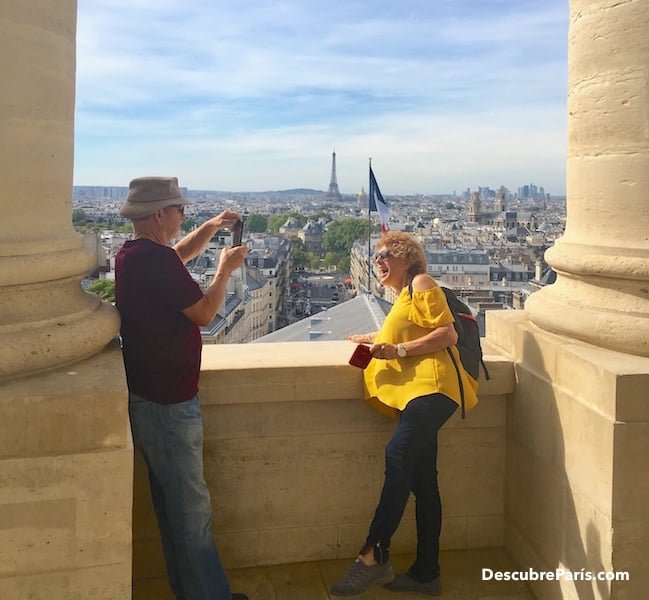
Between April and October, and paying an extra fee of 3€, you can access the outside columns of the Panthéon in Paris. There are 206 steps and it is done in three separate flights of stairs, same thing for going down.
After the first flight you can see the inside from above, the insides of the Panthéon and its amazing proportions. Then you can access a mezzanine that will give you interesting views of the Rue Soufflot, the rooftops of Paris, and the Eiffel Tower. Lastly, if you go through a pair of slightly hidden doors (you can see them from the ground floor) you get to the outside columns where you get a 360° view of Paris. We highly recommend it.
Important fact: Who was Saint Genevieve?

Saint Genevieve is the patron saint of Paris, she was an impassioned Christian, often described as a peasant who became part of history towards the end of the Roman domination. In the year 451 Genevieve urged the people to pray and resist the Huns that were circling Lutetia. Thanks to her, Attila is defeated. When she died, in 502, she was buried close by, on top of that famous hill which was considered a sacred place and the center of the city.
Above her grave there was erected a small oratory that became a place of pilgrimage. In the year 508, King Clovis has a basilica built, as a tribute to the apostles, in the same place as the oratory and asks that he be buried next to the Saint who inspired his decision to change the capital of the Kingdom to Lutetia.
She is closely tied to the history of France and precedes Joan of Arc. Just like her, Genevieve represents the ideals of freedom and resistance that the Third Republic advocated for at the end of the Siege of Paris, this is why she is such an important figure within the Panthéon, in the main fresco inside the dome she is immortalized next to kings and emperors.
A suggestion by Descubre Paris:

Whether or not you have time to go inside the Panthéon in Paris, we suggest you find the benches that the City Hall has placed around the building. Some are giant slabs of stone and others are wooden benches carved with the names of 200 women who have made important contributions to different areas of knowledge but erased by history. You can take a little break by the Sorbonne, the city hall for arrondissement 5 and, of course, the beautiful architecture of the Panthéon.
Practical information for visiting the Panthéon in Paris:
This is some good information to have, remember that it may change due to events being held at the Panthéon. For more information go to the official website.
Location: Place du Panthéon, arrondissement 5, at one end of the Luxembourg Gardens.
Schedule: open every day from 10:00 a.m.- 6:00 p.m., except on January 1st, May 1st, and December 25th. Between April and October it remains open until 6:30 p.m.
Price: Adult access costs 11.50€. It is free of charge for people under 18 year of age, and for people between the ages of 18 -25 who are residents of the European Union and people with disabilities with one attendant.
Access to the top part of the Panthéon will be 3€ extra and the audio guide is also 3€.
Access: You can get there by metro, Line 10, the RER B, or by bus with routes 21, 27, 38, 82, 84, 85, and 89. Get our ready-to-download Detailed Guides, available in our online shop, so you can enjoy your Paris visit without wasting any time.
Paris is waiting for you.
A bientôt
The post 5 Things You Need to Know About the Panthéon appeared first on UAT - DescubreParis.com.
]]>Deprecated: Creation of dynamic property WP_Term::$term_order is deprecated in /home/u821052763/domains/descubreparis.com/public_html/uat/wp-includes/class-wp-term.php on line 198
Deprecated: Creation of dynamic property WP_Term::$term_order is deprecated in /home/u821052763/domains/descubreparis.com/public_html/uat/wp-includes/class-wp-term.php on line 198
Deprecated: Creation of dynamic property WP_Term::$cat_ID is deprecated in /home/u821052763/domains/descubreparis.com/public_html/uat/wp-includes/category.php on line 378
Deprecated: Creation of dynamic property WP_Term::$category_count is deprecated in /home/u821052763/domains/descubreparis.com/public_html/uat/wp-includes/category.php on line 379
Deprecated: Creation of dynamic property WP_Term::$category_description is deprecated in /home/u821052763/domains/descubreparis.com/public_html/uat/wp-includes/category.php on line 380
Deprecated: Creation of dynamic property WP_Term::$cat_name is deprecated in /home/u821052763/domains/descubreparis.com/public_html/uat/wp-includes/category.php on line 381
Deprecated: Creation of dynamic property WP_Term::$category_nicename is deprecated in /home/u821052763/domains/descubreparis.com/public_html/uat/wp-includes/category.php on line 382
Deprecated: Creation of dynamic property WP_Term::$category_parent is deprecated in /home/u821052763/domains/descubreparis.com/public_html/uat/wp-includes/category.php on line 383
Deprecated: Creation of dynamic property WP_Term::$cat_ID is deprecated in /home/u821052763/domains/descubreparis.com/public_html/uat/wp-includes/category.php on line 378
Deprecated: Creation of dynamic property WP_Term::$category_count is deprecated in /home/u821052763/domains/descubreparis.com/public_html/uat/wp-includes/category.php on line 379
Deprecated: Creation of dynamic property WP_Term::$category_description is deprecated in /home/u821052763/domains/descubreparis.com/public_html/uat/wp-includes/category.php on line 380
Deprecated: Creation of dynamic property WP_Term::$cat_name is deprecated in /home/u821052763/domains/descubreparis.com/public_html/uat/wp-includes/category.php on line 381
Deprecated: Creation of dynamic property WP_Term::$category_nicename is deprecated in /home/u821052763/domains/descubreparis.com/public_html/uat/wp-includes/category.php on line 382
Deprecated: Creation of dynamic property WP_Term::$category_parent is deprecated in /home/u821052763/domains/descubreparis.com/public_html/uat/wp-includes/category.php on line 383
Deprecated: Creation of dynamic property WP_Term::$term_order is deprecated in /home/u821052763/domains/descubreparis.com/public_html/uat/wp-includes/class-wp-term.php on line 198
Deprecated: Creation of dynamic property WP_Term::$term_order is deprecated in /home/u821052763/domains/descubreparis.com/public_html/uat/wp-includes/class-wp-term.php on line 198
Deprecated: Creation of dynamic property WP_Term::$term_order is deprecated in /home/u821052763/domains/descubreparis.com/public_html/uat/wp-includes/class-wp-term.php on line 198
Deprecated: Creation of dynamic property WP_Term::$term_order is deprecated in /home/u821052763/domains/descubreparis.com/public_html/uat/wp-includes/class-wp-term.php on line 198
Deprecated: Creation of dynamic property WP_Term::$term_order is deprecated in /home/u821052763/domains/descubreparis.com/public_html/uat/wp-includes/class-wp-term.php on line 198
The post Four things you need to know about the Place Vendôme in Paris appeared first on UAT - DescubreParis.com.
]]>
1.It had a tumultuous past
This mythical and harmonious square was commissioned by Louis XIV and gets its name from the landowner at the time, César de Bourbon, Duke of Vendôme, a natural son of Henry IV. Initially it was a rectangular plaza, with a statue of the monarch on a horse in its center. The square became what it is today as different buildings were erected around; high-end buildings where rich noblemen lived.
During the Revolution, the statue of Louis XIV was torn down. 20 years later Napoleon had a column built of 44 meters (144 feet), made with the molten lead from the canyons taken at enemy lines at the Battle of Austerlitz. In 1871, during the Paris Commune, the column was torn down by the initiative of the painter Gustave Coubert (who decided to exile himself to avoid repaying for the column). Today we can see a replica of the last version of the column.
2.It carries an iconic bejeweled history
This square has a strong tradition of jewelry making dating back to 1700. Back then Chaumet was already settled here and creating jewels for the courts of Europe (he was the official jeweler for Empress Joséphine.) Later came Boucheron in 1858 and after that Van Cleef & Arples, Mauboussin, Mikimoto with its pearls, and the Italian Bulgari. Jewelry stores can also be found along the iconic Rue de la Paix, where you can find the famous Cartier Boutique, and across the plaza, on Rue Saint-Honoré, where you can also find Buccellati
Today you can also find master watchmakers like Rolex, Piaget, Patek Philippe and Hublot among others, as well as Chanel, Dior and Louis Vuitton.
3.It houses a deluxe hotel, which further recognized it as a Luxury location
It is considered one of the most beautiful and luxurious hotels in the world, the Hotel Ritz was created by the Swiss hotelier César Ritz, who wanted to create a hotel with all the magnificence fit for a Prince (quite the ambition!) This building cemented the vocation of this iconic plaza.
It opened its doors in 1898, and it quickly became a hotel for famous writers, politicians, artists, intellectuals, designers, tycoons, and different personalities.
Marcel Proust observed Parisian society from this hotel and wrote most of his work from there. Coco Chanel lived there until her death. Ernest Hemingway made it his general headquarters during his stays in Paris; one of the bars was even named after him.
The Ritz was one of the last stops of Lady Di and her boyfriend Dodi-Al Fayed (whose father owned the hotel) before dying in Pont de l’Alma, on August 30th 1997.
4.It hides some interesting facts
- Frédéric Chopin lived and died in this plaza, where you can currently find Chaument (number 12 in the plaza). Sometimes, a few privileged clients of the jeweler get the pleasure of being invited to a private concert at Master Chopin´s old house.
- It is said that Coco Chanel was inspired by the shape of this plaza to design her famous Première watch. if you don´t know it yet, here it is.
- This square is also famous for its sober but very photogenic Chirstmas lights.

La Place Vendôme at Christmas. - Some of the storefronts of these famous jewelry houses are used in publicity and advertising, in elaborate set ups, such as the giant sun that adorned the Louis Vuitton Boutique almost two years ago, which was a reference to the Sun King (le Roi Soleil). An impeccable work by L’Atelier Anthem.

Athem for Louis Vuitton at the Place Vendôme - The square has 158 arches, and in each one of them there is a distinctly different mask. they were all made by the same sculptor (the details really make a difference.)
- The Place Vendôme has appeared in countless fashion catalogues. it often serves as a background for fashion photo shoots. It has appeared in movies, music videos and thousands of pictures with celebrity sightings.
This square is one of our favorite places, it is an open space, harmonious and with luxury items all around. Make sure to walk around the storefronts and arches, remember, window shopping is free.
This plaza can be found in our Detailed Travel Guides Descubre Paris of 3, 4, and 5 days; or we can include it in a Personalized Travel Guide.
A bientôt.

The post Four things you need to know about the Place Vendôme in Paris appeared first on UAT - DescubreParis.com.
]]>Deprecated: Creation of dynamic property WP_Term::$term_order is deprecated in /home/u821052763/domains/descubreparis.com/public_html/uat/wp-includes/class-wp-term.php on line 198
Deprecated: Creation of dynamic property WP_Term::$term_order is deprecated in /home/u821052763/domains/descubreparis.com/public_html/uat/wp-includes/class-wp-term.php on line 198
Deprecated: Creation of dynamic property WP_Term::$cat_ID is deprecated in /home/u821052763/domains/descubreparis.com/public_html/uat/wp-includes/category.php on line 378
Deprecated: Creation of dynamic property WP_Term::$category_count is deprecated in /home/u821052763/domains/descubreparis.com/public_html/uat/wp-includes/category.php on line 379
Deprecated: Creation of dynamic property WP_Term::$category_description is deprecated in /home/u821052763/domains/descubreparis.com/public_html/uat/wp-includes/category.php on line 380
Deprecated: Creation of dynamic property WP_Term::$cat_name is deprecated in /home/u821052763/domains/descubreparis.com/public_html/uat/wp-includes/category.php on line 381
Deprecated: Creation of dynamic property WP_Term::$category_nicename is deprecated in /home/u821052763/domains/descubreparis.com/public_html/uat/wp-includes/category.php on line 382
Deprecated: Creation of dynamic property WP_Term::$category_parent is deprecated in /home/u821052763/domains/descubreparis.com/public_html/uat/wp-includes/category.php on line 383
Deprecated: Creation of dynamic property WP_Term::$cat_ID is deprecated in /home/u821052763/domains/descubreparis.com/public_html/uat/wp-includes/category.php on line 378
Deprecated: Creation of dynamic property WP_Term::$category_count is deprecated in /home/u821052763/domains/descubreparis.com/public_html/uat/wp-includes/category.php on line 379
Deprecated: Creation of dynamic property WP_Term::$category_description is deprecated in /home/u821052763/domains/descubreparis.com/public_html/uat/wp-includes/category.php on line 380
Deprecated: Creation of dynamic property WP_Term::$cat_name is deprecated in /home/u821052763/domains/descubreparis.com/public_html/uat/wp-includes/category.php on line 381
Deprecated: Creation of dynamic property WP_Term::$category_nicename is deprecated in /home/u821052763/domains/descubreparis.com/public_html/uat/wp-includes/category.php on line 382
Deprecated: Creation of dynamic property WP_Term::$category_parent is deprecated in /home/u821052763/domains/descubreparis.com/public_html/uat/wp-includes/category.php on line 383
Deprecated: Creation of dynamic property WP_Term::$term_order is deprecated in /home/u821052763/domains/descubreparis.com/public_html/uat/wp-includes/class-wp-term.php on line 198
Deprecated: Creation of dynamic property WP_Term::$term_order is deprecated in /home/u821052763/domains/descubreparis.com/public_html/uat/wp-includes/class-wp-term.php on line 198
Deprecated: Creation of dynamic property WP_Term::$term_order is deprecated in /home/u821052763/domains/descubreparis.com/public_html/uat/wp-includes/class-wp-term.php on line 198
The post 5 Things You Should Know About the Sainte Chapelle appeared first on UAT - DescubreParis.com.
]]>1. It was built to house the Crown of Thorns of Christ (and 22 other relics):
To gain its name of Sainte, this chapel had to be built to house relics. This is the case of this surprising chapel, commissioned by King Louis IX of France to keep Christ’s Crown of Thorns and also his collection of 21 other relics he had collected. The political reasoning of Saint Louis, who was a very pious king, was to make France the new Christian capital, competing with cities like Rome.
Check this out: Today no relics remain in the place. The Crown of Thorns (or what remains of it) and the Shirt of Saint Louis are now part of the Treasure of Our Lady of Paris (Notre-Dame de Paris). After the fire at Notre-Dame, the relics were moved to the Saint-Germain-l’Auxerrois church, behind the Louvre Museum. They can be visited only the first Fridays of each month and every Friday during Lent at 3:00 p.m.
2. It has two chapels, upper and lower:
The lower chapel is the one that welcomes in visitors (along with the boutiques and gift shops) and seems to be almost like a vault at 23 ft (7 meters) high, held by multiple columns. To the left of the entrance you can find the stairs that will lead you to the upper chapel, where you can witness the play of light, colors, and architecture of this beautiful building.
Check this out: The columns in the upper chapel represent the twelve apostles, pillars of the church of Christ.
3. It counts with 1,113 stained glass windows that narrate episodes of the Bible:
Starting with Genesis to the Apocalypse. Even King Louis IX is represented in one of them. Suggestion: when you arrive, look for the informational cards that are available in several languages for visitors. This will help you better understand the stories behind the stained glass windows. Try to look at them from a distance to better appreciate them.
Check this out: the rosette in the back represents the Apocalypse and was renovated in 1490. During that time renovation meant “keeping up with trends”, therefore certain parts of the building weren’t actually being restored. They were updated to resemble the architectural trend of that time, which was Gothic Flamboyant (this meant flame shapes or fire), and not the original Gothic Rayonnant (referring to strong lines coming out of the center, creating rays of light) which you will likely see at Notre-Dame.

4. The best time to visit is the morning:
Try to get there early since this building, due to its diminutive size, fills up very quickly. Hopefully you get to see the sunlight through the stained glass windows brightening up the space. Imagine it is 1248 and the floor is white, which further reflected the colors of the windows creating an even more…heavenly atmosphere. The visit will take you 45 minutes to an hour. Because the monument is inside the Palace of Justice you will have to go through the corresponding security checks. A lot of people don´t get to see this monument because they get discouraged by the queues outside, remember that it is a small place, but if you get there early you will have no trouble, and it is very much worth the effort.
5. You can buy a bundled ticket to visit the Conciergerie as well:
A few feet away from the entrance to the Sainte Chapelle you will find the Conciergerie which preserves some of the ancient vestiges of the Palace de la Cité and medieval housing for the kings of France. During the French Revolution it served as prison (that is where Marie Antoinnete was held before being sent to the guillotine). Today it also functions as the Palace of Justice and has a building for the Correctional Police. Some wonder why they should pay to visit a church, but this is really a museum with the name of a church, since there is no religous worship inside.
Suggestion: when purchasing your ticket, think about if you’d like to also visit the Conciergerie. The regular ticket to visit the Sainte Chapelle costs 10€ and the Conciergerie costs 9€. If you buy the bundle you will pay 15€ for both (saving 4€).

This building, inspired by the vision of New Jerusalem, is part of our detailed guide Discover Paris in 4 Days which you can get here.
BONUS: You will likely leave through the Palace of Justice, through a big portal of black and golden gates. If that is the case, turn immediately to your left and walk to the corner so you can see the clock tower and in it in the first public clock in Paris. A jewel from 1370.
You can also read our article about the Top 5 churches in Paris.
Address:
Sainte-Chapelle
8, boulevard du Palais
75001 Paris
Metro Cité, Line 4
The schedule for the Sainte Chapelle are:
⦁ From January 2nd to March 31st: Open every day from 9:00 a.m. to 17:00 p.m.
⦁ From April 1st to September 30th: Open every day from 9:00 a.m. to 19:00 p.m.
⦁ From October 1st to December 31st: Open every day from 9:00 a.m. to 17:00 p.m
⦁ Last entrance: half an hour before closing time.
Paris awaits!
A bientôt.
The post 5 Things You Should Know About the Sainte Chapelle appeared first on UAT - DescubreParis.com.
]]>Deprecated: Creation of dynamic property WP_Term::$term_order is deprecated in /home/u821052763/domains/descubreparis.com/public_html/uat/wp-includes/class-wp-term.php on line 198
Deprecated: Creation of dynamic property WP_Term::$term_order is deprecated in /home/u821052763/domains/descubreparis.com/public_html/uat/wp-includes/class-wp-term.php on line 198
Deprecated: Creation of dynamic property WP_Term::$term_order is deprecated in /home/u821052763/domains/descubreparis.com/public_html/uat/wp-includes/class-wp-term.php on line 198
Deprecated: Creation of dynamic property WP_Term::$cat_ID is deprecated in /home/u821052763/domains/descubreparis.com/public_html/uat/wp-includes/category.php on line 378
Deprecated: Creation of dynamic property WP_Term::$category_count is deprecated in /home/u821052763/domains/descubreparis.com/public_html/uat/wp-includes/category.php on line 379
Deprecated: Creation of dynamic property WP_Term::$category_description is deprecated in /home/u821052763/domains/descubreparis.com/public_html/uat/wp-includes/category.php on line 380
Deprecated: Creation of dynamic property WP_Term::$cat_name is deprecated in /home/u821052763/domains/descubreparis.com/public_html/uat/wp-includes/category.php on line 381
Deprecated: Creation of dynamic property WP_Term::$category_nicename is deprecated in /home/u821052763/domains/descubreparis.com/public_html/uat/wp-includes/category.php on line 382
Deprecated: Creation of dynamic property WP_Term::$category_parent is deprecated in /home/u821052763/domains/descubreparis.com/public_html/uat/wp-includes/category.php on line 383
Deprecated: Creation of dynamic property WP_Term::$cat_ID is deprecated in /home/u821052763/domains/descubreparis.com/public_html/uat/wp-includes/category.php on line 378
Deprecated: Creation of dynamic property WP_Term::$category_count is deprecated in /home/u821052763/domains/descubreparis.com/public_html/uat/wp-includes/category.php on line 379
Deprecated: Creation of dynamic property WP_Term::$category_description is deprecated in /home/u821052763/domains/descubreparis.com/public_html/uat/wp-includes/category.php on line 380
Deprecated: Creation of dynamic property WP_Term::$cat_name is deprecated in /home/u821052763/domains/descubreparis.com/public_html/uat/wp-includes/category.php on line 381
Deprecated: Creation of dynamic property WP_Term::$category_nicename is deprecated in /home/u821052763/domains/descubreparis.com/public_html/uat/wp-includes/category.php on line 382
Deprecated: Creation of dynamic property WP_Term::$category_parent is deprecated in /home/u821052763/domains/descubreparis.com/public_html/uat/wp-includes/category.php on line 383
Deprecated: Creation of dynamic property WP_Term::$cat_ID is deprecated in /home/u821052763/domains/descubreparis.com/public_html/uat/wp-includes/category.php on line 378
Deprecated: Creation of dynamic property WP_Term::$category_count is deprecated in /home/u821052763/domains/descubreparis.com/public_html/uat/wp-includes/category.php on line 379
Deprecated: Creation of dynamic property WP_Term::$category_description is deprecated in /home/u821052763/domains/descubreparis.com/public_html/uat/wp-includes/category.php on line 380
Deprecated: Creation of dynamic property WP_Term::$cat_name is deprecated in /home/u821052763/domains/descubreparis.com/public_html/uat/wp-includes/category.php on line 381
Deprecated: Creation of dynamic property WP_Term::$category_nicename is deprecated in /home/u821052763/domains/descubreparis.com/public_html/uat/wp-includes/category.php on line 382
Deprecated: Creation of dynamic property WP_Term::$category_parent is deprecated in /home/u821052763/domains/descubreparis.com/public_html/uat/wp-includes/category.php on line 383
Deprecated: Creation of dynamic property WP_Term::$term_order is deprecated in /home/u821052763/domains/descubreparis.com/public_html/uat/wp-includes/class-wp-term.php on line 198
Deprecated: Creation of dynamic property WP_Term::$term_order is deprecated in /home/u821052763/domains/descubreparis.com/public_html/uat/wp-includes/class-wp-term.php on line 198
Deprecated: Creation of dynamic property WP_Term::$term_order is deprecated in /home/u821052763/domains/descubreparis.com/public_html/uat/wp-includes/class-wp-term.php on line 198
The post Everything You Need to Know to Visit the Eiffel Tower appeared first on UAT - DescubreParis.com.
]]>We want to dedicate a blog post to this wonderful building, just as we love to do in DescubreParis.com, with practical and useful information for visiting the most photographed monument in the world.
First, a Little Bit of History
The Eiffel Tower was built by engineer and builder Gustave Eiffel, a specialist on metallic structures, with the help of 300 workers for the Exposition Universelle of 1889. Its construction took two years. At the time it was the tallest building in the world at 276 meters high (301 yards).
Nowadays, the tower welcomes around 7 million visitors per year and is worth an estimated 434 billion Euros, that is a fifth part of the French GDP.
How is the Eiffel Tower Set Up?

Today, the Iron Lady is framed by a security glass installation at its lower level, the ground level is a patio (parvis), there are three floors (accessible by different ways), and each has different things to observe, besides enjoying the amazing view. It is important to remember this since at the moment of buying your ticket you should know how far up the tower you want, or can, go.
The Patio orParvis
Once you´ve gone through the first access checkpoints you arrive to the patio where you can find:
- Access to the elevators
- Access to the stairs to the first floor
- Restaurant, more like a concession stand
- An incredible view of the internal structure of the tower
- Exits
The First Floor (Premier étage)
- 57 meters above ground (187 Feet)
- Only accessible by elevator (or when coming down from the above floors, or if you have a reservation at the restaurant Le 58 Tour Eiffel)
- It has a 57-meters-long (187 feet) glass floor, to experience a floating view; don´t worry, not the whole floor is like this.
- Viewpoints and rest areas for enjoying the view
- There is a space called the CinEiffel where you can enjoy a video with information on the tower.
- Touchscreens with historical information on the monument
- Here you can find the restaurant Le 58 Tour Eiffel, with a spectacular view to the Trocadéro Gardens. It has two atmospheres: at noon is a relaxed, family restaurant, and at night it becomes a Bistro chic restaurant.
- There is a cafeteria with ready-to-eat meals and a gift shop
The Second Floor (2ème étage):
- 116 meters (380 feet) above ground
- Accessible by elevator or stairs (647 steps up)
- Magnificent view of Paris, do not hesitate to go all the way around
- Here is the famous gourmet restaurant Jules Verne
- A Bar à Macarons, this is a sales-stand of the famous French macarons
- There is a cafeteria with ready-to-eat meals and a gift shop
Top or Sommet
- 276 meters (905 feet) above ground
- The ride up is amazing
- The view will leave you speechless
- You´ll arrive at a closed room with historical information, the way out is through some stairs to enjoy the view.
- This floor has a reconstruction of Gustave Eiffel’s office
- Orientation panels
- A Bar à Champagne to celebrate the privilege of having arrived to the top of this majestic building.
Options For Going Up the Eiffel Tower:
These are the options for going up the Eiffel Tower:
Staircase Ticket to the Second Floor:
Access to the second floor (and first) by the stairs (647 steps). Sold only at the Ticket Se vende únicamente en las taquillas de la torre y para una utilización el mismo día. Booth of the tower and for same-day use. On your way down you can visit the first floor.
Prices:
Adult: 10,40€
Young Person (between 12 and 24 years): 5,20€
Children (between 4 and 11 years): 2,60€
Small Children (under 4 years): free*
Estimated visit time: Between 30 and 45 minutes to go up the 647 steps, plus an hour and a half for looking around.
IMPORTANT:
- It is not advisable to go up the stairs with small children, older folk or people with health issues.
- There is never much queue to go up the stairs, only the brave and physically adventurous can (or want) to do this.
Staircase and Elevator Ticket to the Top:
Access to the second floor by the stairs (647), and elevator to the top. Sold only at the Ticket Booth of the tower and for same-day use. On your way down you can visit the first floor.
Prices:
Adult: 19,70€
Young Person (between 12 and 24 years): 9,80€
Children (between 4 and 11 years): 5,00€
Small Children (under 4 years): free*
Estimated visit time: Between 30 and 45 minutes to the second floor, plus two hours for looking around.
IMPORTANT:
- It is not advisable to go up the stairs with small children, older folk or people with health issues.
- There is never much queue to go up the stairs, only the brave and physically adventurous can (or want) to do this.
Elevator Ticket to the Second Floor:
Access to the second floor through the elevator, on your way down you can visit the first floor. Available online and at the ticket booth.
Prices:
Adult: 16,60€
Young Person (between 12 and 24 years): 8,30€
Children (between 4 and 11 years):4,10€
Small Children (under 4 years): free*
Estimated visit time: an hour and thirty minutes
Elevator Ticket to the Top:
Access to the top of the tower through the elevators. Of course, it allows visits to the second and first floors. The ideal ticket to live the full experience. Available online and at the ticket booth.
Prices:
Adult: 25,90€
Young Person (between 12 and 24 years): 13,00€
Children (between 4 and 11 years): 6,50€
Small Children (under 4 years): free*
Estimated visit time: two hours and thirty minutes
Making Reservations for Le 58 Tour Eiffel**:
Yes, making reservations to have lunch or dinner at this restaurant grants you access to the first floor of the Eiffel Tower, so it’s a good option if you can make it. Lunch plates go from 39€ and dinner from 86€. Reservations are not mandatory, but if you don’t make reservations you will have to purchase any tower ticket and check if there are tables available.
*Small children don’t pay, but must have a Free Entrance ticket.
Going Up the Eiffel Tower: from theory to reality
Visiting the inside of the Eiffel Tower is an unforgettable experience. But like all worthwhile things in life, it requires some “effort”.
It is important to remember that this is a very visited monument and it has a limitation to how many visitors it can hold, this number is constantly being monitored to preserve the safety of the structure. Access to the tower can also be affected by weather or other specific conditions.
It is ideal to buy the tickets beforehand through the official website:
- Go to the official website for the Eiffel Tower and check availability and times.
- Entrance tickets are available up to two months before your desired date, we recommend reserving tickets as soon as you know you will be visiting Paris. Reserve your tickets online for a seamless experience.
- Buy the ticket all the way to the top: it is an unforgettable experience and is worth it.
- Either by night or day it is a beautiful view, just keep in mind that it can get pretty windy all the way at the top, and that in winter access to the top may be disabled due to bad weather. .
- If you are travelling with children under four, you will have to add their ticket to your shopping cart, it is free, but the child must have a ticket to enter.
- Remember that if you want to eat at Le 58 Tour Eiffel you can make reservations and pay online, these reservations will give you access to the first floor. It can be an interesting choice. Just remember this restaurant is close until 2021.
Keep in mind:
- Tickets purchased online are not modifiable
- Get there at the exact time on your ticket, they can deny your access if you don’t.
- You must print your ticket and present it in good shape, the barcode must be legible. There is no way to print at the tower and they won’t accept barcodes on your phone.
- You can access the tower through the East or West entrances, in any case make sure you are waiting in the correct line, there are signs available everywhere (Visitors with a ticket, Visitors with no ticket).
If you tried to buy online but could not or didn’t have time:
- You will have to buy the tickets at the Eiffel Tower ticket booth. You run the risk of there having no more available slots. Remember the tower has a limited weight capacity, if this happens you will be notified of visiting restrictions immediately.
- You will have to choose to either go up by night or day.
- If you would like to do it by day,please make it an early morning, be there as soon as you can, before the booths open (which is the same time the monument opens, 9:00 a.m., which means you will have to be there around 8 a.m. And even so you run the risk of there being too many people, for example during busy seasons.
- If you’d like to go up at night, you should try from 19:00 h. (7:00 p.m.) (7 p.m.).
- We suggest you try very early or very late at night because they are the least visited moments and that way you can use the rest of the day visiting other things.
- The tower has two access and exits, try going to the other side, maybe the booth on the other side is open.
Once inside:
- Follow the instructions of the personnel inside the tower.
- Be patient, there might be a long line of people.
- If you are with your significant other, don´t miss out on the spots marked as “A Place to Kiss”, these are spots where you can take a romantic picture with your partner.
- When you go down, take some time to enjoy the plaza, find the center and look up so you can appreciate the structure of the tower: it´s impressive.
- Enjoy this unique moment.

RESTAURANTS
Le 58 Tour Eiffel:
- ATTENTION: this restaurant is closed for a refurbishment through the beginning of 2021. This prices may change. French Bistrotype restaurant, casual dining at noon and chic and upscale place at night.
- For lunch: menus starting at 39€, with or without reservation. If you have a reservation, be there 30 minutes before the reserved time.
- For dinner: menus starting at 86€, reservation only. There are only two shifts at night, first at 18 h. (6 p.m.) and the second at 21 h. (9 p.m.). (6 p.m.) y el segundo a las 21 h. (9 p.m.).
- Priority access with your reservation.
Le Jules Verne:
- Gourmet restaurant
- Strict dress code: no tshirts, no shorts or casual sneakers. Dress suit and evening dresses.
- Reservation only, at least3 to 4 months in advance.
- Prices begin at 250€ per person.
- Exclusive elevator for restaurant patrons.
For more information on the restaurants:
How to get to the Eiffel Tower?
This will vary depending on where your starting point is, but the main access routes are as follow:
Metro Line 6, Bir-Hakeim Tour Eiffel Stop. 10 minute walk.
Line 9, Trocadéro Stop. 15 minute walk.
Line 8, École Militaire Stop. 15 minute walk.
District (Arrondissement): 16.
Schedule: From 9:00 a.m. to 11:45 p.m., open all days of the year.
Remember that the Eiffel Tower is part of our Detailed Travel Guides. Whether you get to go all the way to the top or not, what’s important is that you saw it in person and you were able to visit a monument that shaped architecture and the lives of everyone in the City of Light.
See you soon!
The post Everything You Need to Know to Visit the Eiffel Tower appeared first on UAT - DescubreParis.com.
]]>